
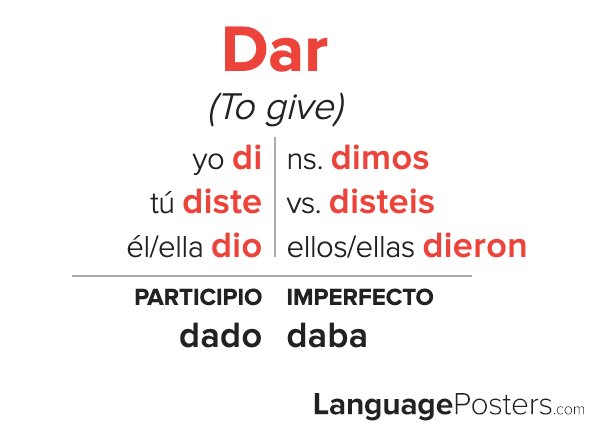

The dar preterite, or past tense form of the verb “dar” in Spanish, adds depth and complexity to your language skills. When you’re expressing actions or events that occurred in the past, mastering the dar preterite is essential. In this article, we will delve into the nuances of conjugating “dar” in the preterite tense, exploring its various forms and how to use it effectively in conversation. Let’s unlock the secrets of the dar preterite and elevate your Spanish proficiency to new heights.

The Magic of Using ‘Dar’ in the Preterite Tense
Welcome, young language learners! Today, we are going to embark on a magical journey into the world of Spanish verbs with a special focus on the verb ‘dar’ in the preterite tense. Get ready to unlock the secrets of this fascinating verb form and discover how to use it to talk about past actions in Spanish. So, grab your language wands, and let’s dive in!
What is the Preterite Tense?
Before we unravel the mysteries of ‘dar’ in the preterite tense, let’s first understand what the preterite tense is all about. In Spanish, the preterite tense is used to talk about actions that were completed in the past at a specific point in time. It is like taking a snapshot of a moment in the past. So, when we use the preterite tense, we are highlighting actions that happened and ended in the past.
Meet the Magical Verb ‘Dar’
Now, let’s meet our main character for today: the verb ‘dar,’ which means ‘to give’ in English. This verb is not just any ordinary verb—it’s a magical one that can help you express generosity, kindness, and so much more in Spanish. When conjugated in the preterite tense, ‘dar’ will take on a whole new form to fit the context of past actions.
Conjugating ‘Dar’ in the Preterite Tense
Conjugating a verb means changing its form to match the subject performing the action. Let’s see how ‘dar’ transforms in the preterite tense for different subjects:
- Yo di – I gave
- Tú diste – You gave
- Él/Ella/Usted dio – He/She/You (formal) gave
- Nosotros/Nosotras dimos – We gave
- Vosotros/Vosotras disteis – You all gave
- Ellos/Ellas/Ustedes dieron – They/You all (formal) gave
Each form of ‘dar’ in the preterite tense has its unique ending that matches the subject, making it clear who performed the giving action in the past. Remember, practice makes perfect, so don’t forget to practice conjugating ‘dar’ to master its preterite form!
Using ‘Dar’ in the Preterite Tense
Now that you know how to conjugate ‘dar’ in the preterite tense, it’s time to put this magical verb into action. Let’s explore some common scenarios where you can use ‘dar’ in the preterite to talk about past events:
1. Giving Gifts
Imagine your birthday party last week. You can use ‘dar’ in the preterite tense to talk about the gifts you received. For example:
“Mi abuela me dio una muñeca preciosa.” (My grandmother gave me a beautiful doll.)
By using ‘dio’ (‘gave’), you are highlighting the specific action of giving that took place in the past.
2. Offering Help
If you helped a friend with their homework yesterday, you can express that using ‘dar’ in the preterite tense:
“Le diste tu libro para que pudiera estudiar.” (You gave him/her your book so he/she could study.)
Here, ‘diste’ (‘you gave’) shows the kind action of offering help that happened in the past.
3. Expressing Generosity
When talking about a charitable act someone did in the past, you can use ‘dar’ in the preterite tense to emphasize their generosity:
“Los vecinos nos dieron comida cuando estábamos en apuros.” (The neighbors gave us food when we were in trouble.)
In this sentence, ‘dieron’ (‘gave’) reflects the kind gesture of giving that occurred in the past.
Practice Makes Perfect
Now that you’ve learned about the magic of using ‘dar’ in the preterite tense, it’s time to practice and incorporate this verb into your Spanish conversations. Remember, the more you practice, the more confident you will become in using ‘dar’ to talk about past actions.
¡Hasta luego! (See you later!)
That concludes our adventure into the world of ‘dar’ in the preterite tense. Keep exploring the wonders of Spanish verbs, and don’t forget to spread the magic of language learning wherever you go!
Irregular Preterite Cucaracha Song – Remastered (HD)!
Frequently Asked Questions
What is the conjugation of “dar” in the preterite tense?
In the preterite tense, the conjugation of the verb “dar” (to give) is “di,” “diste,” “dio,” “dimos,” “disteis,” and “dieron” for the respective subjects yo, tú, él/ella/usted, nosotros/nosotras, vosotros/vosotras, and ellos/ellas/ustedes.
When is the preterite tense of “dar” typically used?
The preterite tense of “dar” is often used to talk about completed or specific actions in the past. It is commonly used for narrating a sequence of events or expressing actions that occurred at a defined point in time.
Can you provide examples of sentences using the preterite form of “dar”?
1. Ayer le di un regalo a mi amigo. (Yesterday, I gave a gift to my friend.)
2. Ellos me dieron las gracias por la ayuda. (They thanked me for the help.)
3. Le diste las llaves a tu hermana. (You gave the keys to your sister.)
Final Thoughts
In conclusion, using the verb “dar” in the preterite tense can be a powerful tool in Spanish communication. The preterite form of “dar” expresses giving or providing something in the past. Practice with conjugating “dar” in the preterite to improve fluency. Remember, mastering the preterite tense of “dar” will enhance your ability to recount past events accurately. Keep practicing to become more proficient in using “dar preterite” in your conversations.